
How Does a Sump Pump Work? The Pit, Pump and Discharge Explained for Toronto Homes
Dealing with this at your property?
Get help nowHow does a sump pump work? It sits in a pit in the lowest part of your basement, and when groundwater fills the pit a float switch starts the pump, which pushes the water out through a discharge pipe. In Toronto and the GTA that pipe should end on the ground outside, away from the house.
That is the whole job, and it is why a pump that fails during a storm matters so much. If you want the pit, pump, alarm and backup looked at together, see our sump pump service and backup installation.
This guide walks through each part in order, explains how sump pump work differs from a backwater valve or a sewage pump, and lists what to check so you know yours is ready before the next heavy rain.
What does a sump pump do in a basement?
A sump pump removes groundwater from the pit under your basement floor before it can rise onto the floor. The City of Toronto describes the arrangement on its page on preventing basement flooding: weeping tile can "send it into a sump pit in your basement, where a sump pump removes it."
Weeping tile, also called a foundation drain, is a perforated pipe around the footing. Toronto's sewer code (Chapter 681 of the Municipal Code) defines a foundation drain as a pipe that collects groundwater and conveys it "to a sump pump for disposal on the surface of the ground or to a private service connection." In plain terms, the pump is the exit for water the drain collects.
How does a sump pump work, step by step?
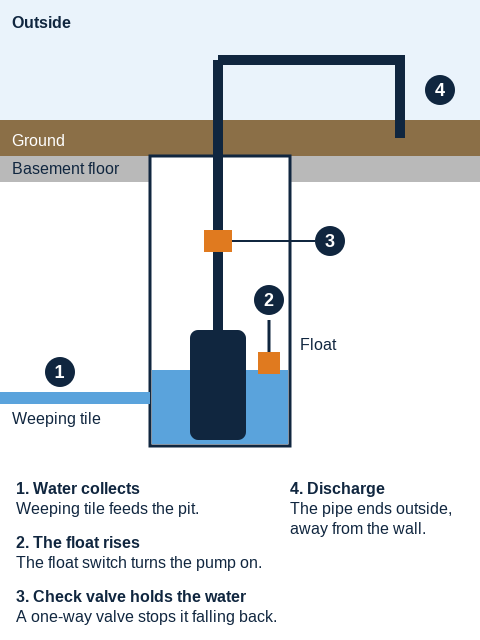
The cycle has four steps: water collects in the pit, the float rises, the motor pushes water up the discharge pipe, and a check valve holds it there. Everything else is detail on one of those steps.
| Step | What happens | What can go wrong |
|---|---|---|
| 1. Water collects | Weeping tile or the soil under the slab feeds groundwater into the pit | Blocked or collapsed drain tile means less water reaches the pit, and the problem shows up elsewhere |
| 2. The float rises | A float on the pump or on its own arm lifts as the water level climbs and closes a switch | A float that jams against the pit wall never switches the pump on |
| 3. The pump moves water | The motor spins an impeller that pushes water up the discharge pipe | A worn motor can hum or run and still move little water |
| 4. The check valve holds | A one-way valve stops water in the pipe from falling back into the pit | A missing or stuck valve makes the pump re-pump the same water |
When the pit empties, the float drops, the switch opens and the pump stops. Some pumps use a pressure or electronic switch instead of a float, but the idea is the same: the water level decides when the pump runs.
Where should a sump pump discharge?
The City of Toronto says a sump pump should empty onto a permeable surface, such as a lawn, garden or gravel, at least two metres from the foundation wall. That wording appears on the City's Basement Flooding Protection Subsidy Program page.
Two common mistakes come from ignoring that. A pipe that ends beside the wall sends the water straight back down to the footing, so the pump cycles again and again. A pipe that runs into a floor drain or sink sends clean groundwater into the sewer system, which is a poor use of a system that is already stressed in a storm.
In winter a discharge pipe can freeze at its outlet. The pump then runs against a blocked pipe, so look at the outlet after a cold snap and clear it if you can do so safely.
What parts make up a sump pump system?
A working system has a pit, a pump, a float or switch, a discharge pipe with a check valve, and ideally an alarm and a backup. Each part has one job.
- The pit (sump basin). A lined hole in the slab that collects the water and gives the pump something to sit in.
- The pump. Submersible pumps sit in the water; pedestal pumps have the motor mounted above the pit.
- The switch. Usually a float, which tells the pump when to start and stop.
- The discharge line and check valve. The pipe that carries water out, and the one-way valve in it.
- The alarm. A high-water alarm tells you when the pit is filling faster than the pump empties it.
- The backup. A second pump or a battery that keeps the pit pumping when the power fails. Our guide to battery backup for a sump pump compares the setups.
The City of Toronto recommends that homeowners "consider installing a back-up power source for your sump pump." Its subsidy page lists a sump pump alarm as eligible work and treats a battery backup as an optional extra. If you are choosing between pump designs, our guide to a submersible pump for sump pits vs pedestal pumps compares them side by side.
Why does a sump pump stop working?
The City of Toronto lists "sump pump (used to pump weeping tile water) failure" among the reasons water gets into a basement. The causes we see named most often are power loss, a stuck float, a worn pump, a blocked discharge pipe and a pit that fills faster than one pump can empty it.
Power loss is the awkward one, because the same storm that raises the water table can knock out the electricity. A pump that was never tested can also fail the first time it is asked to run, which is why a yearly test matters.
A slow failure can be as costly as a sudden one. Water that seeps past a struggling pump can soak flooring and the bottom of drywall for hours before anyone notices, and mould can start within 24 hours of water first touching a material.
How do you check that your sump pump is working?
Pour water into the pit until the float lifts, confirm the pump starts, and watch the water leave through the discharge pipe. Then check that the pump stops when the pit empties and that the alarm sounds if you lift the float by hand.
- Listen for a normal running sound, not grinding, rattling or a motor that hums without moving water.
- Confirm the float moves freely and is not touching the pit wall.
- Look at the outlet outside and make sure the water lands on the ground, two metres or more from the wall.
- Remove visible debris from the pit, and keep the pit cover on if it has one.
- Do the test before spring and before a forecast storm, not during one.
Our free sump pump size calculator is a useful next step if you are not sure your pump is large enough for the inflow.
Is a sump pump the same as a backwater valve or a sewage pump?
No. A sump pump removes groundwater from weeping tile, a backwater valve stops sewage from coming up through drains, and a sewage ejector pump lifts wastewater from basement fixtures. They solve different problems, and many basements need more than one.
Our comparison of a sump pump versus a backwater valve explains which failure each one covers. The City of Toronto also notes that sewage ejector pumps are not covered by its Basement Flooding Protection Subsidy Program, so do not assume a rebate that fits a sump pump fits a sewage pump.
The City also says that if your weeping tiles are connected to the sewer, it recommends homeowners "disconnect it and install a sump pump and/or backwater valve." Our guide to the Toronto basement flooding subsidy covers who can apply.
What if my basement floods even with a sump pump?
If water is coming in anyway, the pump may have failed, the pit may be overwhelmed, or the water may be coming from a different source such as a sewer. Turn off power to the wet area if it is safe to do so, keep out of standing water and get help before materials stay wet.
Our basement flood restoration team extracts water, dries the structure and checks moisture, and our flood damage restoration page covers larger losses. Our guide on what to do after a basement flood lists the first steps in order. We bill your insurer directly. You pay only your deductible. We do not decide what your policy approves.
What to have ready before you call
- The make and age of your pump, if you know them, and whether it has a battery or second pump.
- Whether the pump has run in the past month, and whether an alarm is fitted.
- Where the discharge pipe ends outside, and how far that is from the wall.
- Whether the basement is finished and what sits on the floor above the pit.
- Any history of water coming in during storms.
When you are ready, contact us for a free assessment and send those details. A written scope and price follow the assessment, and we explain the options before any work starts.
To have the whole system checked together, start with our sump pump service and backup installation page.
Frequently asked questions
How does a sump pump know when to turn on?
Most sump pumps use a float switch. When groundwater fills the pit, the float rises with the water and closes a switch that starts the motor. When the pit empties, the float drops and the pump stops.
Does a sump pump run all the time?
No. A working pump runs only when water in the pit reaches the float level. If yours runs constantly, the water table may be high, the check valve may be failing, or the discharge may be sending water back toward the house.
Where does the water from a sump pump go?
It should go out through a discharge pipe onto a permeable surface such as a lawn, garden or gravel, at least two metres from the foundation wall, according to the City of Toronto. It should not be sent to a floor drain or sink.
What is the difference between a sump pump and a sewage pump?
A sump pump removes groundwater collected by weeping tile. A sewage ejector pump lifts wastewater from basement fixtures such as a toilet or laundry sink. The City of Toronto notes that sewage ejector pumps are not covered by its Basement Flooding Protection Subsidy Program.
What happens to a sump pump when the power goes out?
A standard sump pump stops, because it runs on household electricity. A battery backup or a second battery-powered pump keeps the pit pumping, and an alarm tells you when it has switched on.
Water, fire, or mould emergency in the GTA?
45-minute emergency response. Documented, insurance-ready work. We answer 24/7/365.
Call (416) 900-3508 Send the details insteadGet help with your property
Calling is fastest for an active emergency. Send the details and our team follows up right away.