
Battery Backup for Sump Pump: How It Works and Which Setup Protects a Finished Basement
Dealing with this at your property?
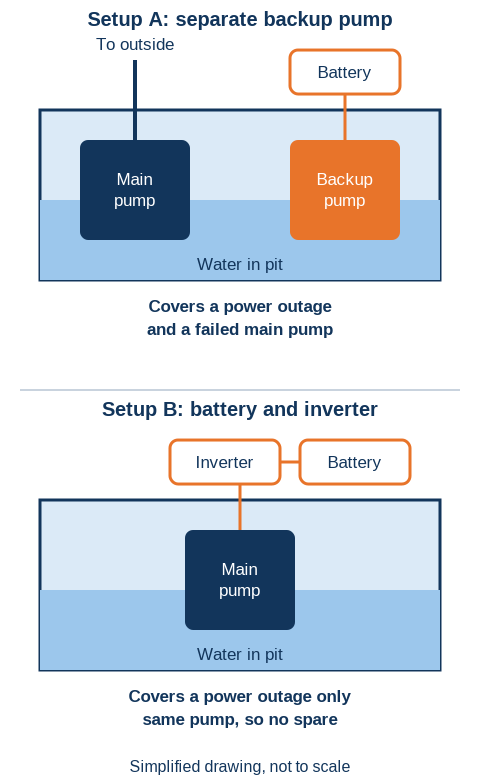
Get help nowBattery backup for sump pump systems keeps your basement pumping when the power goes out. Two setups do it: a second battery-powered pump in the same pit, or a battery and inverter that run your existing pump. In a finished Toronto or GTA basement, a separate backup pump with a high-water alarm is the safer default.
The reason is simple. A battery only fixes a power outage, while a second pump also covers the day your main pump simply wears out. If you want a pump, backup and alarm assessed together, see our sump pump service and backup installation.
The rest of this guide helps you choose between the setups, work out roughly how long a battery will carry the load, and decide what else the pit needs. If your basement already has water in it, jump to the section on what to do next.
What does a battery backup for a sump pump actually do?
A battery backup for a sump pump takes over when mains power fails, so water that keeps rising in the pit still gets pushed outside. Without it, a storm that knocks out power also switches off the one device holding groundwater back.
The City of Toronto lists "sump pump (used to pump weeping tile water) failure" among the causes of basement flooding on its basement flooding page. Heavy rain is also when the water table is highest and outages are most likely, so the two problems tend to arrive together.
A backup system has three parts: a power source (the battery), a way to use it (a second DC pump or an inverter), and ideally an alarm that tells you it has switched on. Without the alarm, a backup can run for hours while nobody in the house knows anything went wrong.
Which battery backup setup suits your basement?
For most finished basements, a separate battery-powered backup pump is the best fit. An inverter that runs your existing pump is simpler to add but leaves you with one pump, and a water-powered pump suits only some homes.
| Option | Best for | Limits | What it means for time and effort |
|---|---|---|---|
| Separate battery-powered backup pump | Finished basements, homes with one aging pump | Needs room in the pit for a second pump and its own float switch | Installed beside the main pump; the work is mostly fitting, wiring and a discharge connection |
| Battery and inverter running your existing pump | A newer, reliable main pump and a tight pit | One pump only, so a failed pump is not covered; the pump draws more power than a DC unit | Fewer parts inside the pit, but the battery bank has to be larger for the same run time |
| Water-powered backup pump | Homes on municipal water with steady pressure | Uses water from your plumbing and depends on the water supply being available | Needs no battery, so no battery replacement; confirm the local water rules first |
| Alarm only, no backup | A secondary space where occasional water is tolerable | Warns you but does not pump anything | Quick to add, but you have to be home and able to act |
If you are not sure which fits, our sump pump size calculator is a free place to start, since the backup should be able to move as much water as the main pump you are relying on it to replace.
Can you add a backup battery to an existing sump pump?
Yes. You can add a battery and inverter to the pump you already have, or add a second pump with its own battery beside it. Which one is right depends on how old your main pump is and how much room the pit has.
If your main pump is more than a few years old and you have a finished basement above it, adding a second pump gives you protection against both failure types for a similar amount of work. If the pump is new and the pit is tight, the inverter route is reasonable, provided you accept that you still have one pump.
The City of Toronto's Basement Flooding Protection Subsidy Program lists installation of a sump pump, alarm and battery backup power as eligible work. The page does not say whether a battery can be added on its own to an existing pump, so ask the City before you assume it can.
How long will a battery run a sump pump?
Run time is battery capacity divided by what the pump draws, then cut down by how often the pump actually runs. You can estimate it with simple arithmetic, but the real numbers are on your pump's and battery's labels.
Here is a hypothetical example, not a measurement from any home. Suppose a battery has 50 amp-hours of usable capacity and the backup pump draws 8 amps while it is running. Running without a break, it would last about 6 hours (50 divided by 8). If the pit only fills enough for the pump to run 30 per cent of the time, the same battery stretches to roughly 20 hours.
The point of the example is the shape of the answer: a longer outage during a heavy storm uses the battery far faster than a light one, because the pump runs more often. If a multi-day outage is realistic where you live, ask what the battery can do at your pump's draw, and treat a generator as a separate question.
| Pump runs | Hours of backup |
|---|---|
| All the time | About 6 |
| Half the time | About 12 |
| 30 per cent of the time | About 20 |
What else can stop a sump pump?
A battery only solves a power cut. Sump pumps also fail from a stuck float switch, a pump that has worn out, a blocked or frozen discharge pipe, or a pit that fills faster than the pump can move water. If you want to see how each part works first, read how does a sump pump work.
- Stuck float switch. The pump never turns on, even though it has power.
- Worn-out pump. A pump can run, hum and still move no water.
- Blocked or frozen discharge. The pump runs but the water has nowhere to go.
- Overwhelmed pit. In a severe storm, inflow can exceed what one pump handles, which is where a second pump helps.
Mould can start within 24 hours of water first touching a material, so a pump that fails overnight matters even if you catch it in the morning.
Where should the pump discharge?
The City of Toronto says a sump pump should empty onto a permeable surface such as a lawn, garden or gravel, at least two metres from the foundation wall. It presents this as guidance rather than a condition of the subsidy.
A backup pump has to follow the same rule. Two pumps that both discharge close to the house simply recycle water back toward the footing. A check valve on the discharge line stops pumped water from running back into the pit once the pump shuts off. If your two pumps share one discharge pipe, the connection needs to be done so that one pump cannot push water backwards through the other.
Is a backup pump the same as a backwater valve?
No. A sump pump with backup handles groundwater from the weeping tile, while a backwater valve stops sewage from coming up through a floor drain. Our comparison of a sump pump versus a backwater valve explains which problem each one solves, and our data post on Toronto backwater valve permits by ward shows where valves are being installed.
Many basements need both, because groundwater and sewer backup are different failures. If sewage has already come up, read what to do after a sewage backup first, because that water is not safe to handle.
Does Toronto help pay for battery backup?
The City of Toronto's subsidy program names battery backup power as eligible work for single-family, duplex, triplex and fourplex homes. We are not listing amounts here because the City has changed them recently; check the City's page for the current figures.
According to the City, if you install a sump pump and a battery backup together, your contractor must itemize the cost of each component separately on the invoice. It also says the contractor needs a valid City of Toronto business licence at the time of work, and that you submit photos of the sump pump and discharge pipe at the exterior with your application. Our guide to the Toronto basement flooding subsidy for Etobicoke homes walks through the application.
How do you test and maintain a backup system?
Test the main pump and the backup separately, because a pump you never run is a pump you do not know works. Pour water into the pit until the float lifts and confirm the pump starts and the water leaves through the discharge pipe, then cut the main pump's power and watch the backup do the same.
- Check that the alarm sounds and that you can hear it from where you sleep.
- Look at the battery's age and condition. Batteries wear out, so use the manufacturer's replacement interval rather than guessing.
- Clear debris from the pit and confirm the discharge pipe is open and free.
- Keep the charger plugged in, and check any indicator light after a storm.
The best time to test is before the spring thaw or a forecast storm, not during one.
What if water has already come into the basement?
Stop adding to the problem first: if it is safe, turn off power to the wet area, get the water moving out, and call a restoration team before the materials stay wet. Mould can start within 24 hours of water first touching a material, and finished basements hold a lot of material that stays wet.
Our basement flood restoration team extracts water, dries the structure and checks moisture, and our flood damage restoration page covers larger losses. Our guide on what to do after a basement flood lists the first steps in order. We bill your insurer directly. You pay only your deductible. We do not decide what your policy approves.
What to have ready before you call
- The make and age of your main pump, if you know them, and whether it has a battery today.
- Whether the basement is finished, and what is on the floor above the pit.
- Where the discharge pipe comes out and how far from the foundation.
- Whether the pump has run in the last month and whether an alarm exists.
- Any outage or flooding history for your street.
When you are ready, contact us for a free assessment and send those details. A written scope and price follow the assessment, and we will explain the options before any work starts.
To have the whole system looked at together, start with our sump pump service and backup installation page. Your main pump type matters too, and our guide to a submersible pump for sump pits vs pedestal pumps compares the two.
Frequently asked questions
Do I need a battery backup for my sump pump?
If your basement is finished or holds anything you cannot afford to lose, yes, because a power outage during a storm turns off the pump when it is needed most. A basement with nothing of value in it and a history of staying dry carries less risk. A second pump with its own battery also protects you if the main pump fails.
What is the difference between a backup battery and a backup pump?
A backup battery with an inverter powers the pump you already have. A backup pump is a second, separate pump in the same pit that runs on a battery. The second option covers a failed main pump as well as a power outage.
Can I add a backup for my existing sump pump?
Yes. You can add a battery and inverter to the existing pump or install a second pump beside it. The right choice depends on the age of the main pump and how much room the pit has.
How long does a sump pump battery last in an outage?
It depends on the battery's capacity, what the pump draws and how often the pump runs. As a hypothetical, a 50 amp-hour battery feeding an 8 amp pump would last about 6 hours of continuous running, and longer if the pump runs less often. Check the figures on your own pump and battery.
Does the City of Toronto subsidize a sump pump battery backup?
The City of Toronto's Basement Flooding Protection Subsidy Program lists installation of a sump pump, alarm and battery backup power as eligible work. Amounts have changed recently, so check the City's page for the current figures. If a pump and battery are installed together, the contractor must itemize each component on the invoice.
Where should a sump pump discharge in Toronto?
The City of Toronto advises discharging onto a permeable surface such as a lawn, garden or gravel, at least two metres from the foundation wall. Keep the discharge pipe clear and check it before winter.
Water, fire, or mould emergency in the GTA?
45-minute emergency response. Documented, insurance-ready work. We answer 24/7/365.
Call (416) 900-3508 Send the details insteadGet help with your property
Calling is fastest for an active emergency. Send the details and our team follows up right away.