
Submersible Pump for Sump Pits vs Pedestal Pumps: Which Suits Your Basement
Dealing with this at your property?
Get help nowA submersible pump for sump pits is the better fit for most finished basements in Toronto and the GTA, because the whole pump sits in the pit, runs quietly and works under a sealed lid. A pedestal pump suits a narrow pit and a basement where noise and a sealed lid matter less.
If you are choosing now, the pit, the lid and the discharge matter as much as the pump type. Our sump pump service and backup installation page explains how we look at all three together.
This guide compares the two designs side by side, says which one suits which situation, and lists what to have ready before you ask for a written quote.
What is the difference between a submersible pump for sump pits and a pedestal pump?
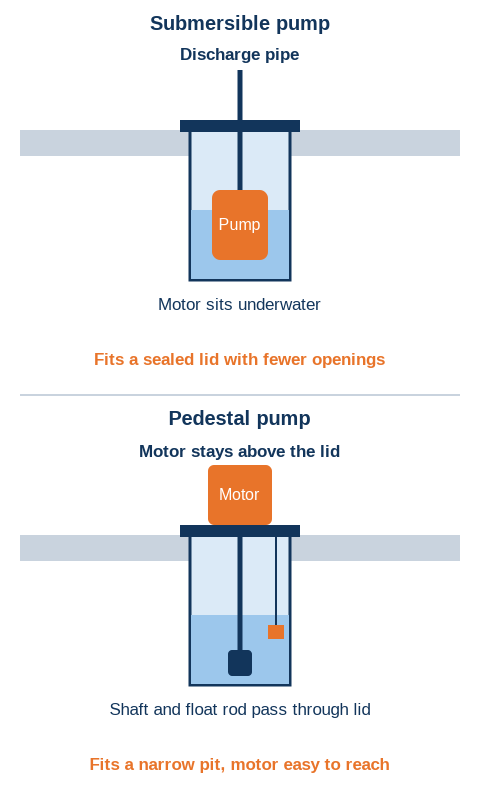
A submersible pump sits at the bottom of the pit, under the water, with a sealed motor. A pedestal pump keeps the motor on a stand above the pit and reaches down with a shaft to a small pump at the bottom.
That one difference drives everything else. Because the motor of a pedestal pump is out of the water, it is easier to reach and usually cheaper, but it is more visible and can be noisier. A submersible pump is quieter and out of sight, but you have to lift it out of the pit to service it.
| Question | Submersible | Pedestal |
|---|---|---|
| Where is the motor? | Inside the pit, under the water | On a stand above the pit |
| Noise | Quieter, because the water muffles it | Louder, because the motor is in open air |
| Narrow pit | Needs room for the whole pump and its float | Fits a narrower pit |
| Sealed lid or radon pipe | Fewer openings through the lid | Shaft and float rod pass through the lid |
| Servicing | Lift the pump out of the pit | Motor is at hand above the lid |
| Finished basement | Usually the better match | Possible where noise is not a concern |
Which is the best sump pump for a finished basement?
There is no best sump pump for every basement, but for a finished basement a submersible pump is usually the safer match. It is quiet enough to live above, it leaves the room free of a motor on a stand, and it works with a closed lid.
A pedestal pump can still be the right answer in an unfinished utility basement with a narrow pit. The deciding questions are the pit size, whether the lid must be sealed, how much noise you will accept, and how easily someone can reach the pump to check it.
Does the Ontario Building Code say which pump a sump needs?
The Ontario Building Code does not name a pump type. Section 9.14.5.2 of its housing rules says that where gravity drainage is not practical, a covered sump with an automatic pump must be installed, and that the sump cover must resist removal by children and be sealed.
We read that wording in the 2012 text that was published before the 2024 edition took effect, so confirm the current article number and wording with your local building department. Either design can be installed to meet the idea of a covered pit with an automatic pump; the cover and the sealing are where the two differ in practice.
The City of Toronto's own subsidy page is also silent on pump type. It lists the installation of a sump pump, an alarm and battery backup power as eligible work, and it says your contractor must itemize the cost of each component separately on the invoice.
Which pump works better with a sealed lid or a radon pipe?
A submersible pump is the easier one to seal, because nothing but the discharge pipe and the power cord has to pass through the lid. A pedestal pump needs its shaft and float rod to move up and down through the cover, so the lid cannot be completely airtight.
That matters if a radon system draws air from the pit. If you have not tested the house, our radon testing page explains how we approach it, and our guide to radon testing in the GTA compares short-term and long-term tests. A radon contractor should decide how the lid is sealed, and the pump has to stay serviceable under it.
Which pump suits a narrow sump pit?
A pedestal pump suits a narrow pit better, because only the pump head and float go down the pit while the motor stays above. A submersible pump needs room for the whole pump body and a float that can rise freely.
A float that jams against the pit wall can stop a pump from switching on at all, so the free movement of the float is worth checking in any pit, whatever the pump type. Our guide to how a sump pump works shows where the float sits in the cycle.
How do I size the pump, whichever type I pick?
Pump type is the second decision. The first is whether the pump can move the water your pit receives in a heavy rain, and our sump pump size calculator gives you a starting figure to take into that conversation.
A bigger motor is not automatically better. A pump that is too large for the pit can start and stop in short bursts, and a pump that is too small can fall behind in a storm. That is a question for the person who sees the pit, the weeping tile and the discharge together.
Where must the sump pump discharge, and does pump type change it?
The City of Toronto says a sump pump should empty onto a permeable surface, such as a lawn, garden or gravel, at least two metres from the foundation wall. That rule is the same for a submersible and a pedestal pump, as the City's Basement Flooding Protection Subsidy Program page sets it out for the sump pump itself.
A discharge pipe that ends beside the wall sends the water back down to the footing, so a good pump can run all night and still not solve the problem. If you are unsure where your pipe ends, trace it outside before you choose a pump.
Does a submersible pump need a battery backup?
Any sump pump stops when the power goes out, and storms are when power is most likely to fail. The City of Toronto says sump pumps can lose power during severe storms, and recommends that you consider a back-up power source.
The City also lists sump pump failure, along with weeping tile failure, among the causes of basement flooding on its basement flooding page. Our guide to battery backup for a sump pump compares the common setups, and a submersible primary pump pairs with either of them.
Sump pump or backwater valve: do I need both?
They do different jobs. A sump pump removes groundwater from the weeping tile, and a backwater valve stops sewage from coming back up the sewer line, so one does not replace the other. Our comparison of a sump pump and a backwater valve explains when a home needs each.
What should I have ready before I ask for a written quote?
A few facts let us give you a clear written scope for a pump replacement or a new pit. The assessment is free.
- Photos of the pit with the lid off and of where the discharge pipe ends outside.
- Whether the pit has a lid and whether it is sealed, and whether a radon pipe is connected.
- What the current pump is and whether it has ever run dry, hummed or failed.
- Whether the basement is finished and how close the pit is to living space.
- Whether you already have an alarm or a battery backup.
- Any flooding history in the home, in your own words.
If a leak or flood has already happened, our basement flood restoration and flood damage restoration teams answer around the clock. We bill your insurer directly where a claim applies, and your deductible stays yours. Coverage depends on your policy.
Ready to choose? Ask about sump pump installation and backup or contact us with the photos above for a written quote after a free assessment.
Frequently asked questions
Is a submersible pump for sump pits better than a pedestal pump?
For most finished basements, yes. A submersible pump is quieter, out of sight and easier to fit under a sealed lid. A pedestal pump is a reasonable choice for a narrow pit where noise is not a concern.
Can a pedestal pump work under a sealed sump lid?
Not completely. The shaft and float rod of a pedestal pump must move through the cover, so the lid cannot be airtight. If radon is a concern, a submersible pump is the easier one to seal.
Which type is easier to service?
A pedestal pump is easier to reach because the motor sits above the lid. A submersible pump has to be lifted out of the pit, so ask that the pit leave room to do so.
Does the City of Toronto require a submersible pump?
The City's subsidy page does not name a pump type. It lists the sump pump, alarm and battery backup power as eligible work, so the choice is a fit question for your pit rather than a City rule.
Does the Ontario Building Code require a sump pump?
Section 9.14.5.2 of the Ontario Building Code housing rules says that where gravity drainage is not practical, a covered sump with an automatic pump must be installed. Check the current article wording with your local building department.
Where should a sump pump discharge in Toronto?
The City of Toronto says onto a permeable surface at least two metres from the foundation wall. The rule is the same whichever pump type you choose.
Water, fire, or mould emergency in the GTA?
45-minute emergency response. Documented, insurance-ready work. We answer 24/7/365.
Call (416) 900-3508 Send the details insteadGet help with your property
Calling is fastest for an active emergency. Send the details and our team follows up right away.