Scarborough Flooding: Blocked Sewer Reports by Ward, 2022 to 2025
Dealing with this at your property?
Get help nowScarborough flooding shows up in City of Toronto 311 data as a steady trickle, not a storm spike: our analysis found 5,384 blocked sewer line reports from six Scarborough wards between 2022 and 2025, about 3.7 a day. Scarborough Southwest and Scarborough Centre filed 58 per cent of them. If a drain is backing up now, our sewage backup restoration team can contain and clean it.
Data downloaded November 17, 2026. We counted every City of Toronto 311 request typed "Sewer Service Line-Blocked" in the four full calendar years the City publishes, 2022 to 2025, and kept the six wards that make up Scarborough. These are reports residents made, not confirmed sewer failures. The section "How we counted" explains the limits.
How many blocked sewer line reports does Scarborough file?
Scarborough filed 5,384 blocked sewer service line reports from 2022 to 2025, which is 18.5 per cent of the 29,040 filed across all of Toronto. The yearly total barely moves: 1,354 in 2022, 1,392 in 2023, 1,342 in 2024 and 1,296 in 2025.
| Year | Scarborough reports | All of Toronto |
|---|---|---|
| 2022 | 1,354 | 7,064 |
| 2023 | 1,392 | 6,792 |
| 2024 | 1,342 | 8,472 |
| 2025 | 1,296 | 6,712 |
| Total | 5,384 | 29,040 |
The flat line is the story. Toronto as a whole jumped to 8,472 reports in 2024, but Scarborough did not follow: its 2024 total was lower than 2023. On July 16, 2024, the day of the big storm, Toronto logged 694 blocked sewer line reports and Scarborough logged 48, the most it had on any day in the four years.
Which Scarborough wards report the most?
Scarborough Southwest (Ward 20) filed 1,704 reports and Scarborough Centre (Ward 21) filed 1,419. Together that is 3,123 of 5,384, or 58 per cent. Scarborough North (Ward 23) filed the fewest, 329.
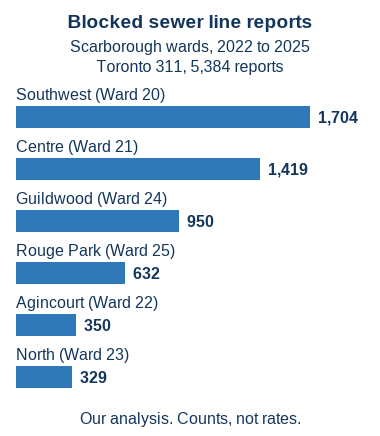
| Ward | Blocked line | Catch basin | Main backup |
|---|---|---|---|
| 20 Southwest | 1,704 | 421 | 26 |
| 21 Centre | 1,419 | 326 | 47 |
| 22 Agincourt | 350 | 255 | 20 |
| 23 North | 329 | 196 | 6 |
| 24 Guildwood | 950 | 319 | 28 |
| 25 Rouge Park | 632 | 406 | 14 |
| Total | 5,384 | 1,923 | 141 |
Wards differ in size and in how many homes are on older sewer lines, so these are counts, not rates. The pattern still shows that the south and centre of Scarborough report blocked private sewer lines far more often than the north. The reports about catch basins, the street drains, are spread much more evenly across the six wards.
What is a blocked sewer service line?
A sewer service line is the pipe that carries a home's waste from the house to the City's sewer under the street. In the 311 data, a blocked line report is a resident telling the City that water or waste is not leaving the property. The City of Toronto's own instruction is to report basement flooding to 311, so that is the first call, ahead of any cleanup.
When the line is blocked on your side, the first sign is often a slow floor drain or a toilet that gurgles. If sewage has come up, keep people and pets out, do not run water, and read our sewage backup checker for the steps in order.
Are street drains and sewer main backups a bigger problem in Scarborough?
Catch basin reports are growing even though blocked service line reports are not. Scarborough filed 396 catch basin blocked or flooding reports in 2022, 478 in 2023, 411 in 2024 and 638 in 2025, a 61 per cent rise from 2022 to 2025. The ward counts above show where.
Sewer main backup reports run the other way. There were 59 in 2022, 41 in 2023, 20 in 2024 and 21 in 2025, 141 in all. These are small numbers, so we would not read a trend into them.
Which parts of Scarborough report the most? A postal area view
By the first three characters of the postal code, M1K, M1N, M1L and M1R lead, with 546, 545, 529 and 523 blocked sewer line reports. M1P follows with 431. Postal areas do not match ward lines, so use this as a second view of the same 5,384 reports, not a ranking of streets.
What has Toronto done about basement flooding in Scarborough?
The City's Basement Flooding Protection Program ran Environmental Assessment studies in 67 areas of Toronto from 2006 to 2024, and eight of them cover parts of Scarborough. According to the City's Basement Flooding Protection Program map, those are Study Area 33 (Scarborough Waterfront), 52 and 57 (South Scarborough, Highland Creek West and East), 56 and 64 (Rouge River South and North), 59 (South Scarborough, Highland Creek), 60 and 63 (Agincourt, Highland Creek West and East). Study Area 59 spans all six Scarborough wards.
All of those studies were completed by 2024, according to the City. The City says selected projects go onto a five-year list presented to Council each year, and that the improvements "do not guarantee flood prevention." Studies are not construction, so check your own street through 311 before you assume work is planned.
What should you do first when a basement floods in Scarborough?
The City of Toronto says to report basement flooding to 311, call Toronto Hydro to shut off power if water has reached outlets or the panel, limit toilet and sink use if a sewer backup is possible, and call your insurer as soon as you can. Keep children and pets away from the water, and take photos before anything is moved.
- Stay out of a flooded basement if water is near outlets, the panel or appliances.
- Call 311 to report the flooding or the blocked sewer.
- Call your insurer and photograph everything before it is moved.
- Stop running water into the house if sewage may come back up the drain.
- Call a restoration team the same day, because mould can start within 24 hours of water first touching a material.
Our basement flood restoration page covers what happens after you call, and our Scarborough restoration services page explains how we respond in the area. The water damage restoration in Scarborough page covers the drying and repair side. For what to do hour by hour, see what to do after a basement flood.
Does Toronto help Scarborough homeowners prevent the next one?
Yes, through the City's Basement Flooding Protection Subsidy Program, which is open to owners of single-family, duplex, triplex and fourplex homes in Toronto. According to the City's subsidy page, eligible work includes a home plumbing assessment by a licensed plumber, a backwater valve with an alarm, a sump pump with an alarm and battery backup, and foundation drain pipe severance and capping.
Rules to check before you start: downspouts must be disconnected from the City sewer or exempt, a backwater valve needs a building permit and an inspection before it is covered, and the application must be made within two years of installation. The City says processing can take up to 10 weeks and that submitting an application does not guarantee a subsidy. Questions go to [email protected]. Our subsidy eligibility checker walks through the rules, and sump pump vs backwater valve helps you choose which to install.
If you want the same view for the rest of the city, see our analysis of blocked sewer line reports in Toronto by ward, our look at backwater valve permits in Toronto, and our guide to where Etobicoke floods.
How we counted
Data set: 311 Service Requests (Customer Initiated), City of Toronto Open Data, downloaded November 17, 2026. We used the annual files for 2022, 2023, 2024 and 2025 and kept every row whose Service Request Type is "Sewer Service Line-Blocked", "Catch Basin - Blocked / Flooding" or "Sewer main-Backup", whatever its status. We counted by creation date and kept rows whose ward field is one of the six Scarborough wards, numbers 20 to 25, as the City records them. We did not use 2026, which is not a complete year, or any year before 2022.
We counted each figure twice, once by reading the files row by row with Python's csv module, and once with a separate table recount; both gave identical totals for year, ward, postal area and day. Limits: the City says the data is a subset of 311 contacts and counts requests as the caller described them. A report is a resident's call, not a confirmed sewer failure, and one blocked line can generate more than one call. We show no addresses, only totals.
Contains information licensed under the Open Government Licence (Toronto).
If your basement has flooded, send us what you see on our contact page and we will arrange a free assessment and a written scope.
Frequently asked questions
How often do Scarborough homes report a blocked sewer line?
Our analysis of Toronto 311 data found 5,384 blocked sewer service line reports from the six Scarborough wards between 2022 and 2025, about 3.7 a day. The yearly total stayed between 1,296 and 1,392. These are reports from residents, not confirmed sewer failures.
Which Scarborough wards report the most blocked sewer lines?
Scarborough Southwest (Ward 20) filed 1,704 reports and Scarborough Centre (Ward 21) filed 1,419 from 2022 to 2025. Together that is 58 per cent of the Scarborough total. Scarborough North (Ward 23) filed the fewest, 329.
Who do I call if my Scarborough basement floods?
The City of Toronto says to report basement flooding to 311, to contact Toronto Hydro to shut off power if water has reached outlets or the electrical panel, and to call your insurer as soon as possible. Keep children and pets out of the water and photograph the damage.
Did Scarborough flood as badly as the rest of Toronto on July 16, 2024?
In 311 blocked sewer line reports it did not. Toronto logged 694 blocked sewer line reports that day and Scarborough logged 48, which was still its busiest day of the four years. The reports show residents calling, not how much water fell.
Is Scarborough part of Toronto's basement flooding protection subsidy program?
Yes. The program is open to owners of single-family, duplex, triplex and fourplex homes anywhere in the City of Toronto, and Scarborough is part of the city. Eligible work includes a plumbing assessment, a backwater valve, a sump pump with battery backup and foundation drain pipe severance and capping. Submitting an application does not guarantee a subsidy.
Water, fire, or mould emergency in the GTA?
45-minute emergency response. Documented, insurance-ready work. We answer 24/7/365.
Call (416) 900-3508 Send the details insteadGet help with your property
Calling is fastest for an active emergency. Send the details and our team follows up right away.