
What Property Managers Need to Know About Emergency Restoration
Dealing with this at your property?
Get help nowWhen a pipe bursts on the 14th floor at 3 a.m. and water is making its way down through six suites, the property manager's phone is the first to ring. In that moment, the difference between a contained incident and a six-figure claim isn't luck, it's preparation. The managers who sleep through these events with confidence are the ones who built their property manager emergency restoration plan long before the water started moving.
This guide walks through what experienced Ontario property managers and condo boards should have in place: preferred-vendor relationships, realistic response SLAs, the documentation that protects you with insurers, tenant coordination that prevents complaints, and the multi-unit logistics that make or break a large loss.
The Duty to Mitigate Starts Before the Phone Rings
Across commercial and residential property management, you carry a duty to mitigate, to act reasonably and promptly to limit damage after a loss. Practically, that means you cannot wait until an emergency to figure out who to call. The standard of care expected today is to have an emergency response plan ready to execute at any hour, qualified contractors on call, and a process to document every action you take.
Speed isn't only about damage control. In Ontario's climate, mould can begin to grow within 24 to 48 hours, and recognized water-restoration practice treats rapid structural drying as the goal. A vendor who can extract water and set drying equipment on the same night is mitigating both physical damage and your liability exposure.
Build Preferred-Vendor Relationships Before You Need Them
The single highest-leverage thing a property manager can do is establish a pre-vetted, pre-contracted restoration partner. When the relationship already exists, mobilization happens in hours instead of days, the vendor already knows your buildings, and their documentation already matches what your adjusters expect.
When you're vetting a restoration partner for an Ontario portfolio, confirm:
- Documented water and mould restoration experience, drying logs, containment, safe removal practices, and clear completion reporting should be part of the baseline.
- Proper licensing and insurance, and, in Ontario, WSIB coverage. A contractor without WSIB exposes the corporation to liability if a worker is injured on your property. (FirstLine Restoration is licensed, insured, and WSIB-covered.)
- Genuine 24/7 emergency response with a committed on-site response time. FirstLine responds across the GTA within 45 minutes.
- Multi-unit and high-rise experience, single-family restorers often struggle with the access, elevator, and stakeholder logistics of a condo or apartment tower.
- A track record you can verify, references from other managers, a strong public reputation (FirstLine holds a 5-star Google rating and has served the GTA since 2006).
Put the relationship in writing where you can, and keep the vendor's emergency line in your building's emergency binder. The goal is that any staff member, on any shift, can trigger the right response without hunting for a number.
Define Response SLAs That Actually Mean Something
"24/7 availability" is meaningless without a defined response time. A useful restoration SLA spells out:
- Time to first contact, how fast a live person (not voicemail) answers and dispatches.
- Time to on-site arrival, the committed window for boots on the ground. Anything beyond a couple of hours is too slow for an active water loss.
- Time to extraction and drying setup, when standing water is removed and air movers and dehumidifiers are running.
- Reporting cadence, when you'll receive the initial scope, daily moisture readings, and the final completion report.
For an active escape of water, the practical benchmark is removing standing water within the first 24 hours and getting the structure into a drying regime immediately. A 45-minute on-site response, like FirstLine's, exists precisely so the extraction-and-dry clock starts before the 24-to-48-hour mould window opens.
Documentation Is Leverage, Not Paperwork
On a multi-unit loss, documentation is what wins faster insurance approvals, justifies the scope, and protects the corporation in any dispute over deductible chargebacks. Treat it as a deliverable from the very first minute. A complete incident record should capture:
- Date and time the damage was discovered, and by whom.
- Suspected source and which shutoff valves were used.
- Every affected area and unit, listed individually.
- Timestamped photos and video of the source and all damage.
- Water category and contamination class (clean, grey, or black water), this drives the entire scope and is essential after any sewage backup.
- Vendor names and response times, and a chronological log of actions taken.
- A running communications log with tenants, owners, insurers, and vendors.
A good restoration partner produces most of this for you, moisture maps, daily drying logs, and a documented scope that an adjuster recognizes on sight. That alignment is what turns a contentious claim into a routine one. When you bring in a vendor who specializes in restoration for property managers, this reporting discipline is built into how they work.
Tenant and Owner Coordination
In a residential building, the people inside the affected units are your most visible stakeholders, and the source of the complaints that escalate to the board. Clear, early communication is half the job.
- Notify affected residents immediately with what happened, what's being done, and what to expect (noise from drying equipment, restricted areas, access needs).
- Coordinate unit access in advance. On a multi-unit loss, the restoration crew often needs into several suites, including ones not obviously damaged, to trace moisture. Lining up access keys and resident availability early prevents costly delays.
- Manage displacement. If a unit is uninhabitable, residents will ask about additional living expenses, typically a matter for their own contents/tenant policy. Knowing this in advance lets you answer calmly instead of improvising.
- Keep the board and owners in the loop with the same incident record you're building for the insurer. One source of truth prevents conflicting stories.
Multi-Unit Logistics: Where Big Losses Are Won or Lost
Water doesn't respect unit boundaries. A single failed supply line on a high floor can send moisture down through ceilings, behind shared walls, into hallways and common elements, and into the electrical and elevator infrastructure. The logistical challenge of a multi-unit loss is fundamentally different from a single suite, and it's where an inexperienced vendor falls apart.
A capable multi-unit response handles:
- Mapping the full migration path of the water, not just the obvious wet ceiling, but every cavity moisture has reached, confirmed with meters rather than guesswork.
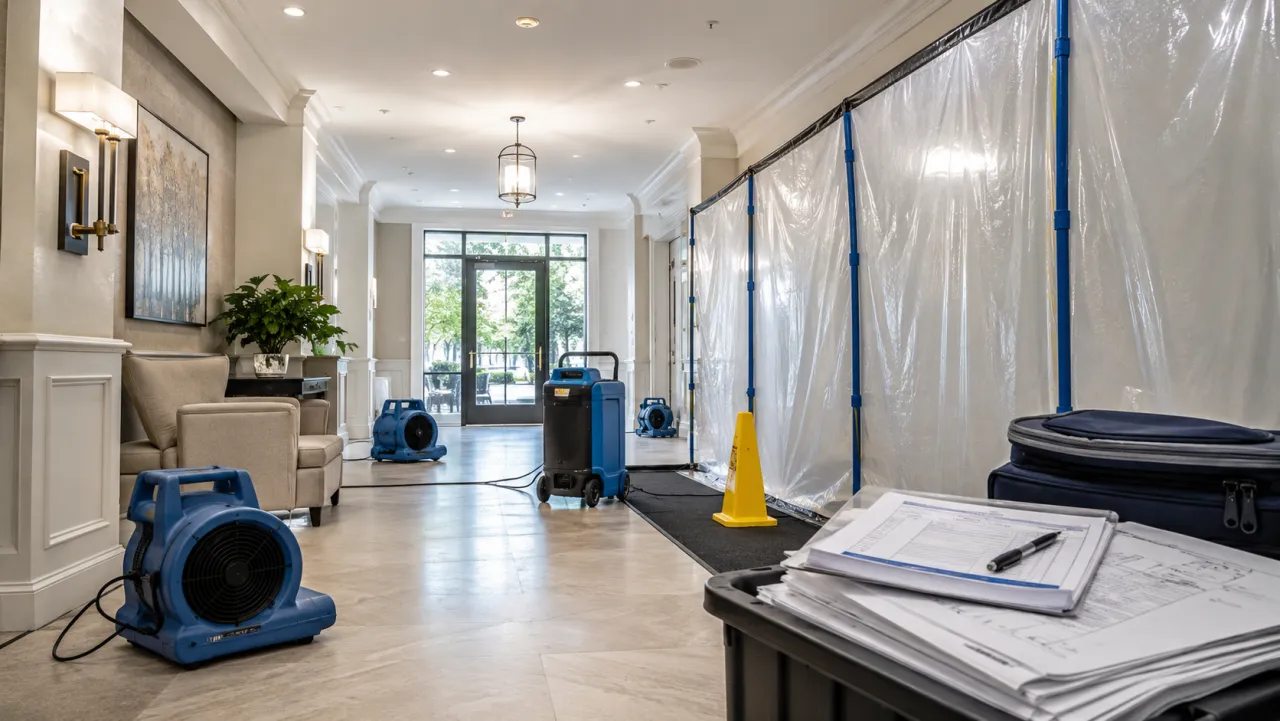
- Staging equipment at scale, enough air movers, dehumidifiers, and crew to dry many areas at once, plus power management so you're not tripping breakers across the building.
- Sequencing access across occupied suites, common elements, and mechanical spaces with minimal disruption.
- Protecting common elements and clean areas with containment so the work doesn't spread dust and contamination through the building.
- Coordinating trades, plumbers, electricians, and rebuild crews, under one point of contact instead of leaving you to project-manage five companies.
This is the difference between a vendor built for houses and one built for buildings. Firms experienced in apartment building restoration and condo and high-rise restoration bring the equipment volume, crew depth, and coordination discipline that a tower-scale loss demands, and they keep you, the manager, as the single informed point of contact rather than a switchboard.
Build Your Emergency Plan Now
The managers who handle emergencies well share one habit: they prepared on a calm day. Before the next loss, make sure your building binder includes pre-vetted emergency contacts, a 24/7 qualified restoration company, an emergency plumber and electrician, your insurer's master-policy contact, and the board or association's key people. Then make sure every shift knows where that binder is.
FirstLine Restoration partners with GTA property managers and condo boards exactly this way: established before the emergency, on-site within 45 minutes when it happens, and documenting every step for your insurer and your board. Licensed, insured, WSIB-covered, and 5-star rated since 2006.
Make FirstLine Your Preferred Restoration Partner
Set up the relationship before the next 3 a.m. call. 45-minute GTA response, documented drying practice, WSIB-covered, and trusted by property managers and condo boards since 2006.
Call (416) 900-3508 or learn more about emergency water damage restoration.
Frequently Asked Questions
Why set up a preferred restoration vendor before an emergency happens?
A pre-vetted, pre-contracted partner mobilizes in hours instead of days, already knows your buildings, and produces documentation your adjusters recognize. Because mould can start within 24 to 48 hours and you carry a duty to mitigate, the time you save by not scrambling for a vendor directly reduces both damage and liability.
What documentation should I capture during a water emergency?
Record the date, time, and discoverer; the suspected source and shutoff valves used; every affected unit; timestamped photos and video; the water category (clean, grey, or black); vendor response times; and a running communications log with tenants, owners, and insurers. A strong restoration partner produces moisture maps and daily drying logs that support faster claim approvals.
How does multi-unit restoration differ from a single suite?
Water migrates across shared walls, ceilings, hallways, and common elements, so the response must map the full moisture path, stage equipment at scale, sequence access across many occupied units, and coordinate multiple trades under one point of contact. Vendors experienced in condo and apartment building restoration handle this; single-family restorers often can't. FirstLine responds across the GTA in 45 minutes, call (416) 900-3508.
Water, fire, or mould emergency in the GTA?
45-minute emergency response. Documented, insurance-ready work. We answer 24/7/365.
Call (416) 900-3508 Send the details insteadGet help with your property
Calling is fastest for an active emergency. Send the details and our team follows up right away.